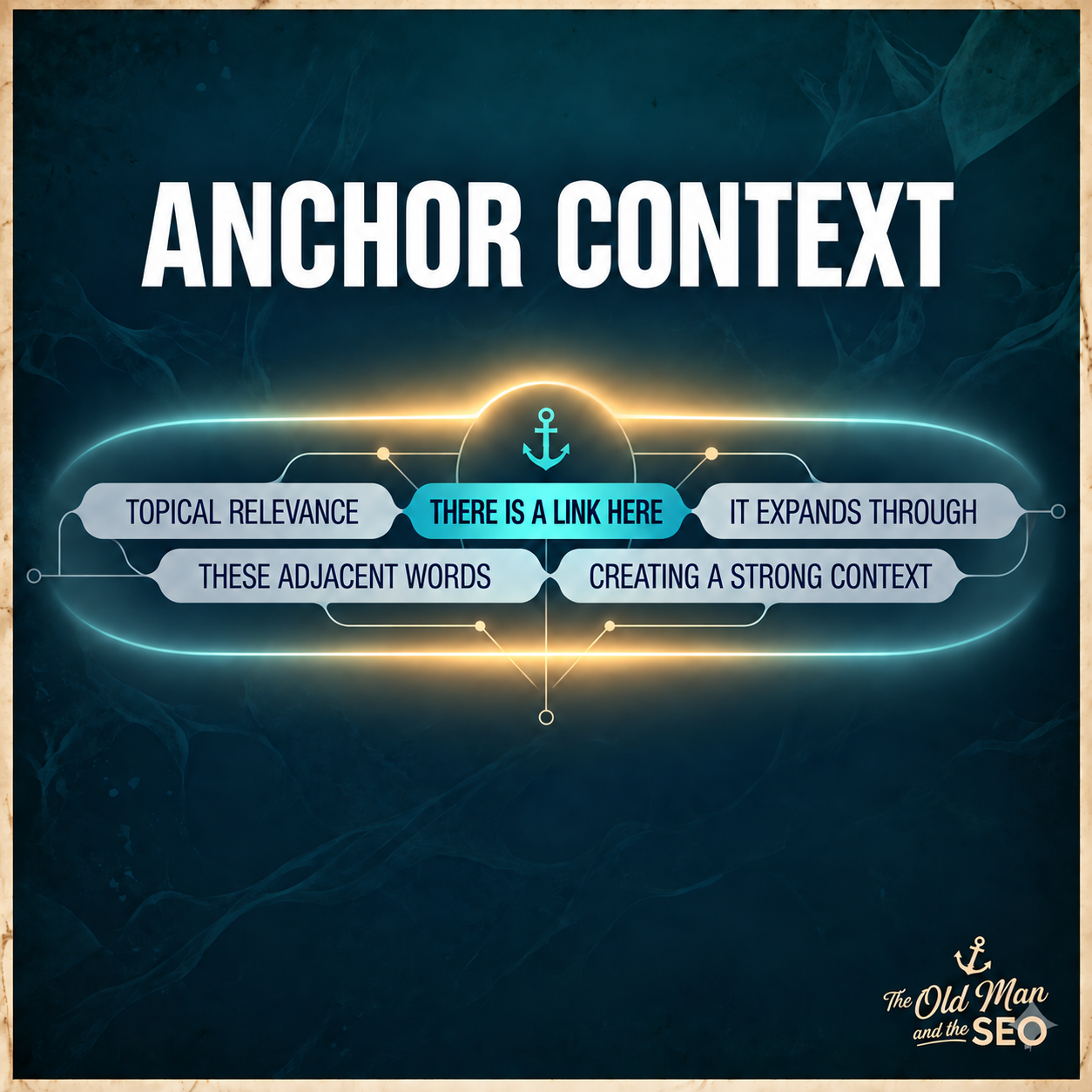
In long-term SEO, very few things truly surprise us. For years, we have observed that a “naked” link or one forced awkwardly into the text does not move the needle in the same way as one that flows naturally with the content. We always knew the surrounding context mattered; the difference is that now, thanks to recent leaks, we know exactly what Google calls it and how far that “context” extends.
The concept is “anchorContext” and, more than a revolution, it is the technical confirmation of a suspicion many SEOs were already applying through pure editorial instinct.
“Anchor Context” or the Formalization of Nearby Relevance
Until now, the official theory focused on anchor text. However, the leaked documents reveal that Google does not isolate the clickable text, but instead uses the surrounding paragraph to strengthen the relevance signal.
What we used to call “topical relevance of the content,” Google processes through specific context metrics:
- The 100-term limit: The leak suggests that Google analyzes between 50 and 100 words around the link to strengthen the message of the anchor.
- Signal amplification: Context does not replace the anchor, it amplifies it. If the anchor text is generic, the context takes the lead. If the anchor is specific but the surrounding context is noisy, the signal weakens.
Confirming Why Some Tactics Fell Behind
Understanding anchorContext helps explain, with data in hand, phenomena we were already seeing in backlink profile audits:
The Loss of Weight in Bios and Fixed Structures
Many of us wondered why links in author boxes had lost strength. The answer lies in the context: a bio paragraph usually talks about the author (“X is a consultant and speaker…”), not about the topic of the linked page. Google reads that context and, when it does not find semantic alignment with the destination, assigns residual value.
The Real Value of “Natural” Links
Sometimes, a link with a poorly optimized anchor text, such as “in this study” or “source,” managed to rank better than expected. Now we know why: if the preceding paragraph is packed with entities and precise technical terminology, the anchorContext more than compensates for the lack of keywords in the link itself.
Adjusting the Roadmap: From the Link to the Paragraph
If we already knew context was important, now that we know its precise limits — those magical ~100 words — our approach to auditing off-page SEO needs to become more meticulous:
- Semantic proximity audit: It is not enough to appear on an authoritative website. The paragraph where the link lives needs to “scream” the topic of the destination. If the guest post writer drifts off-topic right before the link, the value of that link drops.
- Entity density in the surrounding context: Instead of obsessing over exact-match anchor text — which can trigger over-optimization signals — we should obsess over making sure the paragraph contains the LSI terms and entities that define our niche.
- Narrative Coherence: AnchorContext is, in essence, a coherence metric. If the paragraph flows logically toward the link, Google interprets it as a legitimate editorial recommendation.
Conclusion: Fewer “Hacks” and More Structure
The revelation of anchorContext does not change the rules of the game, but it does give us a level of precision we did not have before. It confirms that SEO, once again, is moving away from manipulating isolated tags and toward rewarding complete semantic structure.
In the end, as often happens in this industry over the years, the technical side ends up proving good writing right.

With a solid professional track record, Luciano has been SEO Manager at MD Marketing Digital since May 2018, where he leads a talented team, focusing on search engine optimization and the implementation of effective digital strategies.
Leave a Reply