For years, Search Console operated under a simple premise: you verify a domain, you see its data. The entire architecture of the tool — domain properties, URL prefixes — revolved around a website you owned. If your brand also lived on YouTube, Instagram, or TikTok, that search traffic existed in a kind of black box: you knew Google indexed your videos and profiles, but you had no real way to measure which queries brought people to them, how many clicks they generated, or from which countries.
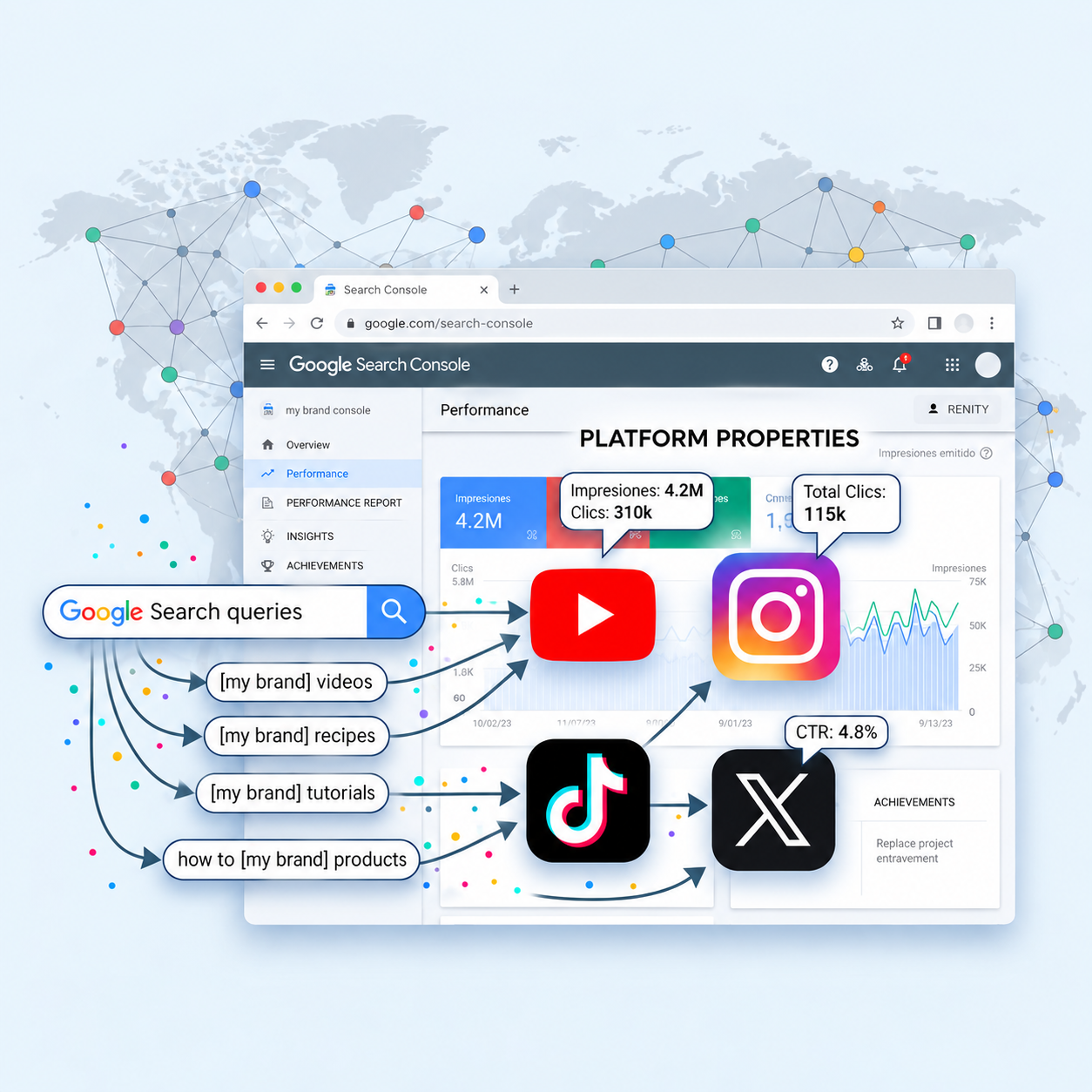
On July 7, 2026, Google formalized something many of us saw coming: “Platform Properties,” a new type of property in Search Console that allows you to verify and monitor Instagram, TikTok, X, and YouTube profiles using the same reports we use for our websites.
What Changes in Practice
The first thing to understand is that this is not a new metric inside an existing report. It is a new type of property, on the same level as domain properties and URL-prefix properties. That is significant: until now, Search Console only understood properties on domains you technically controlled through DNS verification, a meta tag, or an HTML file. Now you can verify an Instagram account or a YouTube channel — properties that live on third-party domains — through OAuth authorization.
Once the property is verified, you get access to three blocks of data:
Performance Report. Clicks, impressions, CTR, and average position, filtered by queries and individual posts. It is the same performance report we already know, but applied to your social content within Google Search and Discover. The data can be exported.
Insights Report. A high-level view with traffic trends, your best-performing posts, and the queries driving visibility. If you already use Search Console Insights for your site, the interface will feel familiar.
Achievements. Growth milestones: reaching a new threshold of clicks from Google Search over the last 28 days, for example. This is more creator-oriented than agency-oriented, but the underlying data is what matters.
The Precedent: From the December Experiment to the Formal Launch
This did not come out of nowhere. In December 2025, Google had launched a limited experiment within Search Console Insights that showed data from social channels associated with a website. That version was more passive: Google automatically detected which social profiles were linked to your domain and added them to the Insights dashboard without allowing you to manually choose or verify them.
The difference with Platform Properties is structural. Now the user initiates the process: you go to the property selector, choose “Add property,” select the platform — Instagram, TikTok, X, or YouTube — and follow the authorization steps. And the data no longer lives only in Insights: it feeds the full Performance Report, with all of its granularity.
What This Means for the Way We Think About SEO
Beyond the mechanics, there is a strategic signal here worth paying close attention to.
Google is moving away from thinking in terms of “websites” and starting to think in terms of “entities.” The fact that Search Console now allows you to verify properties on domains you do not own — instagram.com, tiktok.com, youtube.com — is not a minor detail. It is an acknowledgment that the digital presence of a brand or creator is no longer limited to a domain. It extends to profiles, channels, and posts that live inside closed ecosystems but that Google still indexes and serves in its search results. It is the same logic we saw with anchorContext and the boundaries of the link environment: Google does not evaluate isolated elements, but the full context surrounding them. Only this time, the unit of analysis is not the paragraph around a link — it is the entire digital footprint around a brand.
For agency SEO, the direct implication is cross-platform visibility. If a client’s reel gets impressions in Google for a query the website does not cover, you now have a concrete, measurable content gap that was previously invisible. That convergence of data — web and social in the same panel — allows you to make content decisions with a more complete map of the territory. Tools like the Chrome extensions we already use every day to audit websites are still essential for on-page analysis, but Platform Properties adds a layer that did not exist before: understanding how your social ecosystem competes for the same queries as your domain.
And for creators without a website, the change is absolute. Google was explicit: Platform Properties is also designed for people who do not have their own domain. If your digital presence is entirely social, you now have access to search data that was previously reserved for website owners. It is the first time Search Console formally addresses an audience without web infrastructure.
Queries as the Common Thread
There is one point that deserves special attention: access to the queries that drive traffic to your social profiles. Until now, if you wanted to understand which queries made your YouTube channel appear in Google, you depended on YouTube Analytics — which does not provide that information with the same level of detail as Search Console.
Now, with Platform Properties, you can see exactly what people search for before ending up on your TikTok profile or a YouTube video. That connects directly with how AI engines are breaking searches down into sub-queries to retrieve information: the better you understand which queries drive your visibility — both in Google and in LLMs — the better you can create content that responds to real user intent, regardless of the channel.
What Not to Do
Every time Google opens up a new data source, there is a temptation to optimize for the metric instead of optimizing with the metric. This is not an invitation to publish the same content across four platforms and expect the numbers to multiply. Quality policies — E-E-A-T, actions against duplicate content and spam — operate at the ecosystem level, not just at the domain level.
The real value of Platform Properties lies in understanding where people find you and why. Use that data to create original content that responds to real user intent on each channel, not to replicate the same thing in a different format.
Conclusion: From the Domain to the Full Digital Footprint
For a long time, “doing SEO” was synonymous with optimizing a website. Platform Properties does not eliminate that reality, but it expands it. Google is telling us, through a concrete tool, that the unit of analysis is no longer the URL or the domain: it is the entity — the brand, the creator, the person — and the entire surface through which they interact with search.
For those of us who have been doing this for years, it is not a surprise. But it is the first time Google has given us the tool to measure it.

With a solid professional track record, Luciano has been SEO Manager at MD Marketing Digital since May 2018, where he leads a talented team, focusing on search engine optimization and the implementation of effective digital strategies.
Leave a Reply