Some SEO problems you solve with data. Others you solve by looking at what the neighbors are doing. This one belongs to the second group, although, as usual, the data was there all along. Just not where anyone thought to look.
The client is a private school. I’m not naming it because the story doesn’t need a name, and because the lesson applies to just about any educational institution with a Google Business Profile. Which, by now, is pretty much all of them.
A profile with reviews nobody could see
The school had reviews. Parents had written about the kindergarten, the elementary school, how they’d been treated during an admissions interview. Real reviews, with names and dates, that families could still see in the Contributions section of their own Google accounts.
But none of them appeared on the school’s Business Profile. No stars, no review count, not even a button to leave a new review. As if the school had opened the week before.
The profile wasn’t suspended. There were no warnings in the dashboard. Everything else worked: photos, business hours, questions, traffic to the website. But the reviews section, one of the first things a family looks at when comparing schools on Maps, had disappeared.
I recently wrote about the difference between what you see and what you deliver, and how to audit whether your content actually exists for Google. This was the reverse of that problem: the content existed, Google had it, and yet it wasn’t showing it.
If you work with Google Business Profiles, you know this isn’t unusual. Reviews get delayed, filtered, disappear, and sometimes come back. What’s unusual is having every single review disappear at once and never return.
First, we did what the playbook says
We contacted support. I’m mentioning it because it’s part of the story, not because it helped.
The reply came in May. A templated email listing three possible causes: a review might appear in Google Search but not Maps, in which case you should wait a few days; reviews might be missing after a suspended profile has been reinstated; or a review might have violated Google’s content policies.
None of those explanations seemed to fit. It wasn’t one missing review. It was all of them. The profile had never been suspended. And nobody’s going to convince me that twenty different parents violated the same policy on the same day.
At the bottom of the email was a link to Google’s help page about missing reviews. We opened it, read what looked like the same information we’d just received, and closed it.
Remember that detail. It’ll come back.
Then we did what anyone with experience would do: look next door
If our school’s reviews weren’t showing, what about other schools in the area? We opened Maps and started comparing.
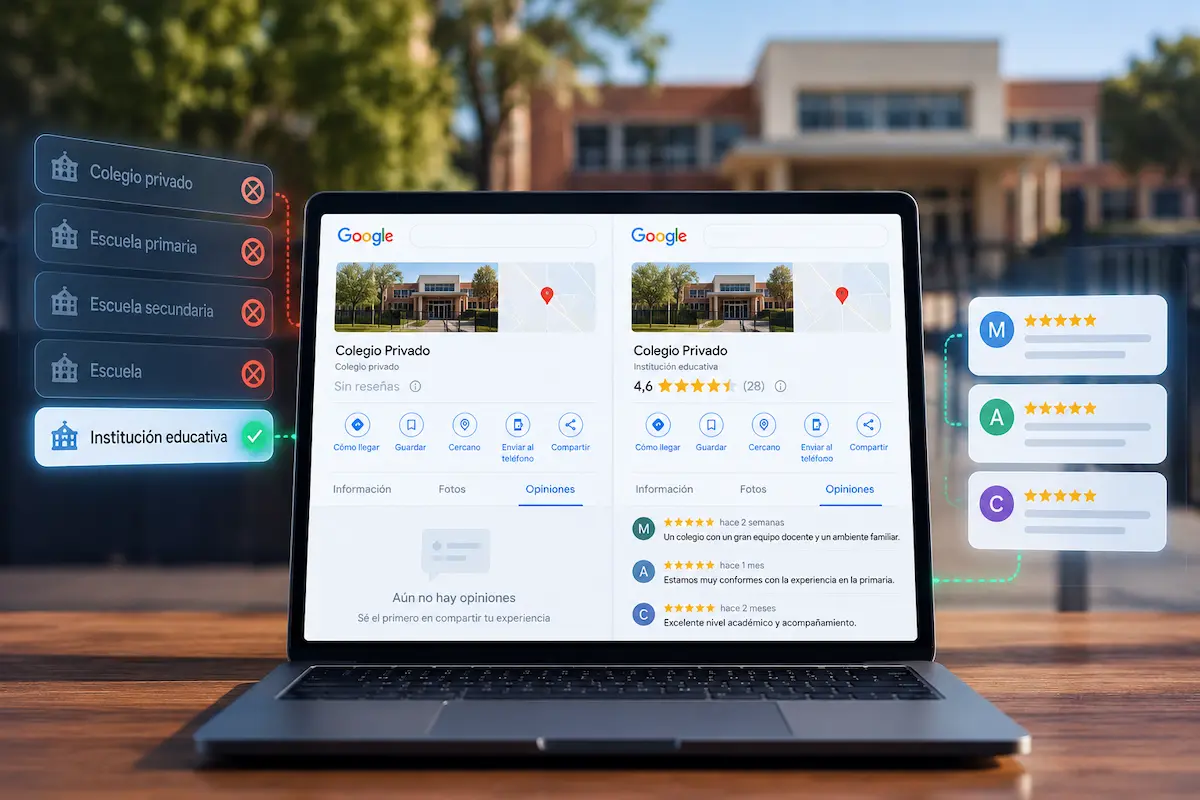
Some were in exactly the same situation: complete profiles, zero visible reviews. Others had their reviews right there, complete with stars and review counts, as if nothing had happened. Same type of institution, same city, same industry.
So the question changed. It was no longer “What did we do wrong?” but “What do they have that we don’t?”
And once you start asking that question, the only sensible thing to do is compare variables one by one, with the patience of someone who knows the difference might come down to one tiny detail.
Verification status: all verified. Profile age: varied, with no apparent relationship. Number of photos, listed hours, website, phone number: no pattern. Whether the owner had replied to reviews: nothing there either.
The difference we found was in the primary category.
The schools displaying reviews had “Educational institution” as their primary category. Those that weren’t showing reviews had “Private school,” “Elementary school,” “Secondary school,” or some other school-specific category.
Our client’s primary category was “Private school.” It was also the most accurate description of what the institution actually was.
Which is precisely why nobody had questioned it.
The change and what happened next
We changed the primary category to “Educational institution” and kept “Private school” as a secondary category. A one-minute change, the kind you make without expecting much.
Google processed the edit and approved it.
Two days later, the reviews were back. Every single one, with its original date. The same reviews families could still see in their accounts, and that the school’s profile had failed to display for months.
The timing was too striking to ignore. We changed one category, and the reviews reappeared. We can’t prove what happened inside Google’s systems, but everything points to that change being decisive.
One word in a dropdown menu had accomplished what months of waiting and a support request hadn’t.
What we discovered afterward, and what had been written down all along
Here’s the part that’s harder for me to tell, because it doesn’t make me look particularly good.
Once the problem was solved, we went back to the help page linked at the bottom of that support email. The same page we’d opened and closed in May.
Except this time, we read the whole thing, including an expandable section about review policies for schools.
The documentation explains that Google decided to remove and disable reviews and ratings on profiles whose primary category identifies them as general education institutions serving students aged 6 to 18. Existing reviews are no longer available, and new ones can’t be submitted.
Universities, kindergartens, and other institutions that don’t provide general education to that age group are excluded from the policy.
And there’s a piece of advice that reads very differently to me now: if the classification doesn’t accurately represent your institution, you can change the category.
The policy began rolling out broadly on April 30, 2025, which lines up with when the school’s reviews stopped appearing.
Google’s reasoning was that school reviews had been attracting low-value contributions, pranks, and off-topic content. Rather than continue displaying that kind of material, it decided to disable reviews and ratings for the profiles covered by the policy.
It wasn’t necessarily a problem with the profile. There was a policy that explained exactly what we were seeing.
And that policy was one click away from the email support had sent us. An email that, it should be said, didn’t mention the policy among any of its three possible explanations.
The answer was right there in writing.
We just hadn’t read to the end.
The catch, which is what really matters
I could end the story here with “Just change the category and you’re done.”
It would make a great headline for a list of SEO tips and a terrible recommendation.
Google didn’t disable school reviews by mistake. It did so deliberately, targeting a specific type of institution: schools providing general education to children aged 6 to 18.
Our client is exactly that.
The fact that “Educational institution” also describes what the school does doesn’t change the fact that “Private school” is more precise. And Google had a reason for applying this restriction to certain educational categories.
The documentation allows businesses to correct a category that doesn’t accurately represent them. It doesn’t say you can change an accurate category to get around a restriction.
That distinction matters.
What we observed is that the change brought the reviews back. What we can’t guarantee is that Google will maintain that behavior, or that it considers this classification appropriate for an institution like this one.
I’d rather put that contradiction on the table than sell the result as some clever trick.
There are three things I told the school, and I’d say the same to any other institution in this situation.
The first is that this may or may not last.
Google can change how it categorizes and classifies Business Profiles. Nothing prevents it from eventually recognizing that a profile with “Educational institution” as its primary category and “Private school” as a secondary category still belongs to an institution covered by the policy.
If that happens, the reviews could disappear again. There’s no guarantee they’ll stay visible.
The second is that when reviews come back, all of them come back. Not just the good ones.
The problem that led Google to introduce this policy is real: school profiles can attract pranks, fake reviews, and off-topic comments. But that doesn’t mean every negative review is fake or comes from an angry student.
A school that gets its reviews back also takes on the responsibility of managing them, responding to them, and reporting those that violate Google’s policies.
That’s work. And it’s the school’s responsibility, not just the agency’s.
The third is that deciding whether to try to recover reviews by changing a category isn’t purely a technical decision.
It’s the school’s decision.
We can explain what’s happening, why it’s happening, what options are available, and the risks that come with each one.
Whether it’s worth doing is a different conversation. And it’s one worth having before touching that dropdown menu.
What I took away from this case
I like to say that the technical evidence eventually confirms what experience already knew.
I wrote that when I shared the case of the listicles we did right and Google still didn’t want. And this case forces me to turn that idea around: here, the technical explanation had been written down from the start, on a help page, inside an expandable section, behind a link at the bottom of a templated support email.
And we got there another way, comparing profiles on Maps one by one until we found the variable.
I don’t know which approach is better. I know which one worked.
And I know that the next time support sends me a link, I’m going to read the whole thing, including whatever is hidden behind an expandable section.
If you have a school as a client and its reviews disappeared after Google started enforcing this policy, now you know where to look.
What you do with that information is another story.
And I hope you’ll tell it.

With a solid professional track record, Luciano has been SEO Manager at MD Marketing Digital since May 2018, where he leads a talented team, focusing on search engine optimization and the implementation of effective digital strategies.
Leave a Reply