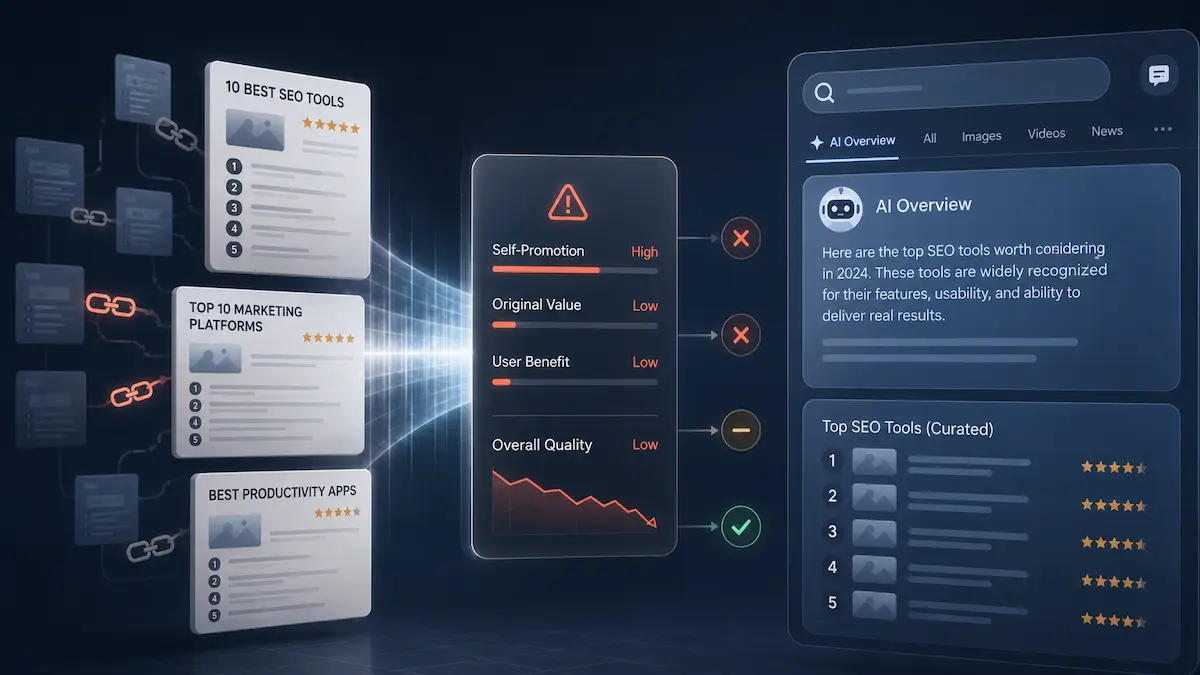
Those of us who have been doing this for years could already see it coming. You don’t need to be a fortune teller, just have a memory: when a tactic works VERY well and VERY fast, sooner or later someone on the other side notices.
In 2025, half of the SEO ecosystem, especially SaaS and B2B, discovered that publishing a “Best X of 2025” on your own blog, with the author’s company ranked number one, was the fastest and most effective way to get cited in AI answers. It worked so well that it was taught in webinars, documented in case studies, and openly shared on LinkedIn. Nobody was hiding it. Some even built reciprocal networks between partner companies: you rank me on your list, I rank you on mine; in other words, we put bricks in each other’s house and both end up living in a mansion.
And it worked. Until, as always happens with these things, it stopped working. In January 2026, visibility graphs started to fall, and not gradually. From one moment to the next, you could hear half of SEO Slack swearing at the top of their lungs.
What follows is the story of what happened, why it happened, and, most importantly for anyone still writing listicles, what actually survived the adjustment.
What Happened Between January and April 2026: The Data
On December 29, 2025, Google completed the December 2025 Core Update. As usually happens, the volatility was not felt immediately: only in January did significant ranking fluctuations begin to appear, as reported at the time by Barry Schwartz in Search Engine Roundtable.
On February 3, 2026, Lily Ray, VP of SEO at Amsive, published an analysis on Substack that gave the phenomenon a name: “Is Google Finally Cracking Down on Self-Promotional Listicles?”. Ray had compiled data from approximately 30 affected sites and found a pattern that repeated with uncomfortable consistency. One day later, on February 4, Glenn Gabe suggested, without official confirmation from Google, that the impact could be linked to an update to the reviews system, and Search Engine Land covered the topic that same day.
The numbers documented by Ray, measured with SISTRIX on organic visibility in the United States, were not subtle: drops of 49%, 43%, 42%, 38%, 34%, and 29%, depending on the site. And here comes the data point that interests me most as a practitioner: those drops were concentrated almost exclusively in blog subfolders (/blog/, /resources/, /guides/), not on product pages or the homepage. The affected sites shared a pattern: between 80% and 90% of their organic visibility depended on informational content published on the blog.
The common pattern also had its own signature: large volumes of “best of” listicles with the author’s company in the first position, titles that changed from “2025” to “2026” without any substantial content changes, a high probability of AI generation according to detection tools, and those reciprocal mention networks between partners that I mentioned earlier.
In March, Bernard Huang, founder of Clearscope, published “Bad News: It’s Not Just Listicles”, an analysis that complicated the initial narrative a little: in Clearscope’s case, self-promotional content explained only 55% of the total decline. The rest came from other formats, such as how-to articles, guides, and “what is” content, with a common denominator different from listicles. That same month came the March 2026 Core Update and the March 2026 Spam Update, with even more volatility: according to industry data, around 80% of the URLs occupying the top three positions changed after that round of updates.
Transparency note: the decline percentages cited come from Lily Ray’s analysis on Substack, replicated in secondary sources, and refer to organic visibility measured with SISTRIX, not traffic, which is a different metric.
The Rules Were Already Written
There is something here that got lost in the public conversation: Google did not invent a new rule in 2026. It applied one that had existed since 2021 more strictly.
Google Search Central’s “Write High Quality Reviews” guidelines, which have been in place for five years, ask for fairly concrete things: first-hand experience with the products being evaluated, evidence of an independent evaluation, transparent methodology with disclosure of conflicts of interest, quantitative measurements instead of generic opinions, and enough content for a ranked list to stand on its own. None of those requirements are new. What was new was that, during 2025, a large part of the industry decided to systematically ignore them.
Lily Ray summed it up with a question that still resonates: how many of the companies appearing in those listicles had actually been customers of all the competitors they claimed to have “evaluated”? In the vast majority of cases, the answer was zero.
The likely mechanism behind the declines is the reviews system, which Google stopped announcing as individual updates because it now operates continuously. Glenn Gabe’s hypothesis, that the January-February volatility was a silent update to that system, fits with another data point: the Quality Rater Guidelines updated in September 2025 had included specific language about “scaled content abuse.”
And if we connect this with E-E-A-T, the diagnosis is straightforward. “Experience” — real experience with what is being evaluated — was absent from self-promotional listicles. “Trust” — transparency about conflicts of interest — is impossible to sustain when the evaluator is also the one being evaluated. Once again, the technical side ended up confirming what experience already knew: a ranking without methodology was always advertising disguised as editorial content.
The Nuance Missing From the Conversation
Now, simply saying “Google penalized listicles” is a simplification that does not do justice to the data. There are at least three legitimate interpretations, and it is worth knowing all of them before jumping to conclusions.
Lily Ray’s interpretation is that Google is specifically devaluing the self-promotional listicle pattern: sites with objective lists created by third parties maintained their visibility intact. Bernard Huang’s interpretation, from Clearscope, broadens the framework: if the impact also hit guides and “what is” content that had nothing self-promotional about it, the cleanest explanation is structural rather than punitive: AI Overviews are absorbing traffic from “high-consensus” queries, regardless of the format in which they are written.
A third interpretation, from Ibrahim Furkan Özçelik in May 2026, adds an interesting twist: according to his analysis, Lily Ray herself may have softened her initial position over time. What Google penalized may not have been a format but a combination of signals: self-ranking without methodology, mass AI generation, and lack of first-hand evidence. Remove those signals and the format survives; the data, Özçelik says, shows it quite explicitly.
My editorial position, after reading all three versions carefully: they are not mutually exclusive. The listicle as a format was never the target; the target was the listicle as a vehicle for self-promotion without substance. But it is also true that the landscape really changed: AI Overviews compress the traffic opportunity for any high-consensus content, whether or not it takes the form of a ranking.
The Other Side: Listicles That Do Work in AI
With all that said, be careful not to throw listicles in the trash. A well-made listicle is still one of the formats most cited by language models. Perplexity in particular loves lists with clear structure, cited data, and real evaluation. What it does not swallow is self-promotion written with someone else’s pen.
The real difference, the one that truly matters, is this: listicle as a format for organizing information — legitimate, effective, perfectly compatible with AI — VS listicle as a vehicle for self-promotion — toxic, and now also ineffective. They are cousins, not siblings, even though during 2025 half the world “confused” them.
What makes a listicle “citable” for AI has to do with fairly clear characteristics: real semantic structure — comparative HTML tables, not decorative divs disguised as tables — concrete quantitative data, cited primary sources, and frequently asked questions aligned with the way people actually ask a chatbot.
And right here appears the current problem, the one that is going to hurt more than a few people: the best way to appear in an AI answer is not to write your own self-ranked listicle, but to earn a place in listicles created by third parties — editorial publications and independent review sites. An interesting example is MKTONS’ independent rankings, which try to do things differently: they compare agencies using an open methodology, combining ranking data, reputation, AI mentions, authority, and digital presence, and letting those variables define the order. In an ecosystem full of paid lists or rankings decided in advance, finding rankings that show the standard they use to measure is already quite a lot.
Nobody said it was easy, but that is how it is. It is exactly what the research from Princeton, Georgia Tech, and IIT Delhi on Generative Engine Optimization, presented at KDD 2024, suggests: distributing presence across diverse publications increases citations in AI answers much more than concentrating everything on your own site.
Best Practices for a Listicle That Ranks, and Does Not Get Destroyed by the Next Update
The first and most obvious thing, even if it is hard to apply: do not put yourself in the number-one position in your own article. If you evaluate competitors, be honest about where you fit and where you do not. And if you truly believe your product is the best in the category, show the specific methodology that supports that claim, with verifiable evidence, not adjectives.
Always show how you evaluated. Did you test the products in practice? With what criteria? For how long? The absence of methodology is still, even today, the clearest sign that a review is empty inside.
Avoid lazy year-swapping. Changing “2025” to “2026” in the title without updating data, analysis, or evaluations is exactly the pattern the reviews system seems to have identified accurately. If you are going to update an article, actually update it.
Include real pros and cons for each item. A listicle where everything is wonderful is not an evaluation: it is a collection of paid mentions in disguise. Honest weaknesses build trust, both with human readers and with the systems that read content to build AI answers.
Back every claim with quantitative data. Research from Princeton and Georgia Tech on GEO showed that adding specific statistics is, individually, the most effective tactic for improving visibility in AI answers, with an estimated improvement of around 41%.
Use real semantic structure: comparison tables built with <thead>, <th>, and <td>, not CSS grids that simulate a table without actually being one. AI systems extract structured tables much more cleanly than plain running text.
Diversify your sources of mentions. Do not concentrate your entire visibility strategy on your own blog. Earning mentions in other people’s listicles — independent reviews, specialized media, editorial publications — is more sustainable and much more resistant to the next round of updates.
And finally: do not build reciprocal listicle networks. The “you rank me, I rank you” model was one of the most visible patterns in the crackdown, and Google interprets it as a manipulative mention scheme, a close relative of the classic link exchange from fifteen years ago.
Spoiler: Google Always Catches Up With You
As we can see, the cycle of SEO strategies repeats itself with a frequency that is as boring as it is predictable.
A tactic works, people scale it until it breaks, abuse it as if it were a credit card with no limit, and it ends up exploding. It happened with keyword stuffing, it happened with PBNs, it happened with aggressive link building in the previous decade, and now it happened with self-promotional listicles. The pattern is never new; what changes, update after update, is the speed at which Google closes the gap. Every time it takes less time, and that also says something.
In the end, what survives every adjustment is always the same thing, so simple that it is frustrating not to have done it from the beginning: content that says something worth saying, backed by someone who has the real experience to say it. There is no shortcut, no matter how clever it may seem at the time, that does not have an expiration date.
And anyone who still has not learned it, don’t worry, because the next update will surely explain it very clearly.

With a solid professional track record, Luciano has been SEO Manager at MD Marketing Digital since May 2018, where he leads a talented team, focusing on search engine optimization and the implementation of effective digital strategies.
Leave a Reply