
Back in July I wrote here that the listicle wasn’t dead. That what Google had knocked down between January and April was the lazy version: the “top 10” with your own company in first place, scaled with AI, traded among friends like baseball cards. And that if you did it with real methodology, without ranking yourself and without charging for a spot, the format still had a place.
I believed it. I still do, in part. But after writing it we did something almost nobody does with their own conclusions: we put them to the test with our own money and time.
This is the result, and it’s not the one we expected.
The experiment: 45 rankings, one methodology, zero self-promotion
The site is a project of our own. I’m not going to name it, and not out of embarrassment: the experiment is still open and I don’t want what I write here to contaminate whatever Google decides to do with it. What I will say is that it’s a site of rankings of professional service providers, covering several Spanish-speaking countries, and that the company publishing it works in the same industry it ranks. That last detail is part of the case, and I’ll come back to it.
The idea was simple. If the problem with listicles was a lack of integrity, let’s make listicles with integrity and see what happens. Between late July and late September we published 45 rankings of the “Best [providers of X] in [country]” type. Six countries, eleven service categories. Plus one standalone piece on a completely different industry, deliberately published with a different structure, so we’d have something to compare against.
Each ranking has a table with around twenty variables per company, measured with our own scripts: where it ranks in Google for the industry’s searches, its Google Business Profile rating with Local Guide reviews separated from new-profile reviews, whether ChatGPT names it when you ask for the best in the country, its Domain Rating, its traffic, its social engagement.
The methodology is published, with the weight of every variable. So is the inclusion criterion: you have to be in Google’s top 10 for the industry’s main keyword. Nobody pays to appear, and we say so in every piece. Every company gets an outbound link, with UTM parameters so they can identify the traffic coming from the ranking. When someone commented asking why a given competitor wasn’t listed, we answered publicly with the criterion.
And the company publishing the site doesn’t appear in any top 10. Not in any of the 45.
In other words: the three things the industry flagged as the sin of the self-promotional listicle (ranking yourself, charging for the spot, having no methodology) we controlled explicitly and verifiably.
What we didn’t control, and this matters, is something else. All 45 pieces share the same architecture: an opening metaphor, an interactive table, a methodology section, a top 10 with a paragraph per company, a closing. They went out in eight weeks. And the project covered six markets and eleven industries from launch, when back in July I myself had written that a new site had to start narrow.
A production decision, not an editorial one. I note it because it’s the center of what follows.
Three weeks of testing on page five
What did Google do with all that? Something more interesting than ignoring it.
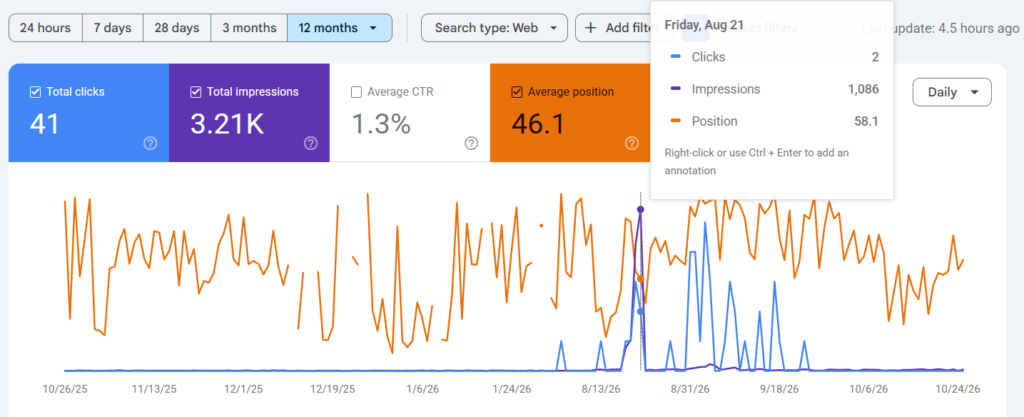
During the first days of August, the pieces started showing up in Search Console. Impressions every day, the odd click, modest peaks in late August and early September. For a domain coming off months at zero, that was a signal. Google had indexed the pages, figured out what they were about, and was showing them in its results.
The detail is where it showed them. The average position across the whole period is around 48. The queries with the most impressions sit between position 50 and 100, with no clicks. They weren’t competing for the top spots. They appeared at the bottom of the results, where almost nobody goes.
And look at the queries. Google correctly identified the country and industry of each piece. But it showed them mainly for commercial searches, the ones from someone looking to hire a provider, not for the comparative queries they were written for.
Searches like “best [providers of X] in [country]” barely showed up at all. Instead, the pieces were competing for “[provider of X]” plain and simple, against the providers themselves and against directories with ten years of history. They joined the line at the back and never moved.
By mid-September, impressions started to drop. By the end of the month they hit zero. And so far in October the silence continues, as if the 45 pieces had never existed.
The date is worth noting: on September 24, Google began rolling out the September 2026 spam update, which finished on October 8 after nearly fourteen days. Google didn’t say which types of content it specifically targeted. I’m not going to claim it was that. But the site’s impression window closes right when that rollout begins, and in this trade a coincidence like that gets written down even if you can’t sign your name to it.
And the control piece, the one with a different structure and a different industry? Five impressions. Average position 16, on a sample that tells you nothing. It went out in late September, in a highly seasonal industry and right as that season was closing, so it isn’t a clean control either. But it showed nothing that would set its behavior apart from the rest.
In short, and without dressing it up: 45 listicles with a public methodology and no self-ranking got visibility for a few weeks, mostly in deep positions. They never came close to the top results and, by late September, stopped generating impressions.
Why that happened is what we still can’t answer.
The template as prime suspect
Here I have to separate what I think from what I can prove, and the gap is wide.
What I think is that the problem was the form. When you control the variables everyone says matter and the result doesn’t change, the reasonable move is to look at what you left uncontrolled.
And what we left uncontrolled was repetition: 45 pieces with the same architecture, the same kind of table, the same narrative device with the metaphor swapped out, published at factory pace. The data in each piece is real and different. The structure never changes.
Google has a name for a practice that resembles, at least on the surface, what we did: scaled content abuse. It added it to its spam policies in March 2024.
It isn’t about using templates or publishing a lot. It’s about producing pages at scale primarily to rank and drive traffic, without adding enough value for the user.
You can debate whether 45 rankings with proprietary data, a public methodology and verifiable criteria fit that description. I’d say not necessarily. But it’s also true that, seen from the outside, 45 articles with the same architecture published in eight weeks can look like serial production.
And that resemblance is part of what I want to investigate.
One distinction matters here: we have no evidence of a penalty. There was no manual action, and we don’t know whether any spam system stepped in. Nor is there any automatic penalty for using a template.
The only observable fact is that the pages had limited visibility, far down the search results, and then stopped generating impressions. My suspicion is that the publishing pattern may have played a part. But I have no way to prove Google read it that way.
Now, what I can prove is much less. And anyone treating this as a settled case is reading me wrong.
First, the control isn’t enough. A single different piece, published off-season, isolates no variable. To confirm the hypothesis we’d need several pieces with different structures on the same site and in the same window. We don’t have them.
Second, the domain had no track record. It had old content unrelated to the topic, no author with a first and last name, no mentions anywhere else. Google’s guidance for review content insists on demonstrable experience, evidence and original analysis. A table full of scripts may be a good starting point, but on its own it doesn’t prove all that.
Third, breadth. Six countries and eleven industries from launch. No vertical ever reached critical mass. We had flagged this as a risk in July, on this very blog, and we did it anyway because production was already set up that way. There isn’t much more to say about it.
Fourth, the SERPs. “[Provider of X] in [country]” is a commercial search dominated by directories and by the providers themselves. For a brand-new site, competing there is hard, template or no template. The data shows our pages appeared very far from the top results. We don’t know how much of that is explained by search intent and how much by the domain’s characteristics.
Google recommends that reviews bring demonstrable experience, original analysis and subject knowledge. We don’t know whether the relationship between the publisher and the companies being evaluated had any effect on rankings. But we can’t rule it out as a weakness of the project either.
Any of those four things could contribute to explaining the lack of traffic. And several probably combined.
The template remains my prime suspect, not because we isolated its effect, but because it was one of the most visible decisions in the project and one we can change in the next test.
That makes it a suspect, not a culprit.
If we were to do it again
And we are going to do it again. So this isn’t hypothetical.
One vertical, one country, until there’s a signal. Then expand. We wrote that rule ourselves and we broke it ourselves; there isn’t much more lesson than that.
The same methodology can be told twenty ways. The table plus the top 10 with a paragraph per company isn’t mandatory. We can open with a head-to-head between two, with an anomaly in the data, with what changed since last year. The data is the same; the piece doesn’t have to be.
Each article should set its own pace, not the production calendar. Forty-five in eight weeks was a logistics decision, and the result is a set of pages that look too much alike.
Identity and demonstrable experience before content volume. A named author, a presence beyond the site, someone who puts a face to the rankings. What I called “real experience” in July isn’t proven by scripts alone; you also have to explain where the knowledge comes from, how the evaluations were done, and why they’re worth trusting.
And choose the intent from the start. Google showed these pieces mainly for commercial searches, and they were written as comparisons of the best providers.
If we’re going to compete in the former, we have to write for what someone looking to hire actually needs. If we’re going for the latter, we have to better understand what the results already ranking offer, and what we can add that doesn’t yet exist.
Neither of those gets solved by publishing more of the same.
What the technique doesn’t tell you
The July article closed with an idea I like and still stand by: that technique, sooner or later, ends up confirming what experience already knew. That self-promotional listicles were going to blow up was obvious to anyone with years in this, long before Lily Ray measured it.
This case forces me to add something.
Sometimes experience has to go looking for the data that technique doesn’t provide. I knew, or thought I knew, that doing things right was enough.
It took a site of our own, 45 pieces and three months of Search Console to start understanding that doing things right doesn’t guarantee Google can recognize it.
Between the value we believe we add and the value a search engine manages to identify, there’s a gap. And that distance is where SEO remains a craft, not a set of instructions.
We’re not shutting the site down. We’re rewriting it. And when we have the control we were missing this time, I’ll share what happens right here, whatever the outcome.

With a solid professional track record, Luciano has been SEO Manager at MD Marketing Digital since May 2018, where he leads a talented team, focusing on search engine optimization and the implementation of effective digital strategies.
Leave a Reply